

ETFS APPROVED: BITCOIN BECOMES AN INSTITUTIONAL ASSET
[IN CRYPTO | Sunday, 14th January, 2024]


⬆️ UPVOTED | ETFS APPROVED: BITCOIN BECOMES AN INSTITUTIONAL ASSET
So, it finally happened: after what felt at times like a torturous, never-ending odyssey, on Wednesday, a raft of spot Bitcoin ETFs were finally approved by the SEC. The odyssey began way back in 2013, when the first spot Bitcoin ETF application was (unsuccessfully) filed by the Winklevoss twins. This time, however, the US regulator was dragged kicking and screaming over the finish line by BlackRock et al — primarily because the agency had shot itself in the foot with its “arbitrary and capricious” arguments in the Grayscale (GBTC) case last year. Irrespective of all the histrionics involved in the final lap (about which more later), the bottom line is that Bitcoin has now well and truly crossed the rubicon — from being widely characterised as an illegitimate form of “magic internet money” by the world of traditional finance (TradFi) to becoming an accepted, kite-marked institutional asset akin to “digital gold”. On the surface level, it may not sound particularly exciting (ETFs don’t exactly set the heart racing after all) but in the broader context of crypto’s mainstream acceptance and adoption, it’s actually a really big deal, representing a significant ‘coming-of-age’ moment for the entire digital asset class — and definitely one for the crypto history books when they come to be written…
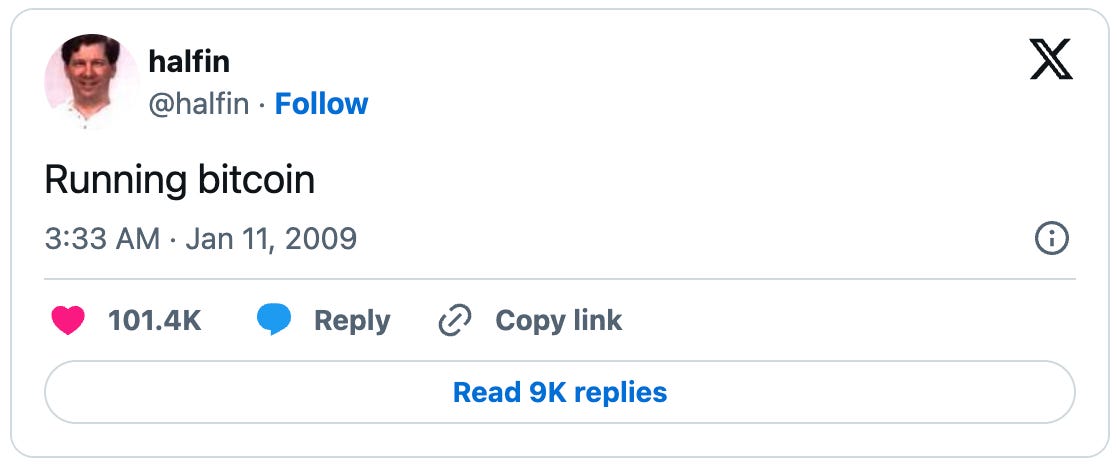
Side note: coincidentally, the ETFs started trading exactly 15 years to the day from when Hal Finney (the very first person to receive Bitcoin from the cryptocurrency’s pseudonymous creator, Satoshi Nakamoto) posted his first tweet on the breakthrough technology.
So, back to the recent ETF approvals: 11 institutional players, representing tens of trillions of dollars worth of assets under management, were all given the green light at the same time. They are (in alphabetical order): Ark Invest, Bitwise, BlackRock, Fidelity, Franklin, Grayscale, Hashdex, Invesco Galaxy, Valkyrie, VanEck, and WisdomTree. In a nutshell, what this means is that anybody with access to traditional US investment vehicles now has easy access to Bitcoin.
So why are these ETFs important?
In addition to the fact that the ETF approvals lend an air of credibility to Bitcoin and the digital asset space more generally, it’s regarded by many as a seminal moment because (as I previously covered here on Substack):
For the lion’s share of institutional investment - managed funds and the like, family offices, pension funds, registered investment advisors (RIAs), etc. - crypto is still way too hot to handle. Obstacles may range from custodial issues surrounding digital assets; to accounting, book-keeping and compliance problems; to an unwillingness to grapple with unquantifiable risks; to simply feeling uncomfortable with the lack of regulatory clarity.
Whereas exchange traded funds (ETFs) on the other hand (and especially those run by the likes of BlackRock and Fidelity) provide investors with a blue-chip product wrapper that ticks all of the existing boxes, and which they can natively plug in to — without changing anything about the way they currently operate.
Of all the stuff I've read and watched concerning the importance of these ETFs, this high-level take by Raoul Pal - whilst talking to Laura Shin on her Unchained podcast - is by far the most interesting and succinct. Pal characterises the spot Bitcoin ETFs as being the equivalent of a free trade agreement between the worlds of TradFi and crypto, which I think is a really insightful (and accessible) way to frame it…
Link to the original Unchained episode here.
When it comes to crypto, the SEC is a total basket case
Of course, this being crypto, the SEC’s final approval process didn’t go entirely according to plan. In addition to the torturous few months leading up to the final decision (during which time Gensler, a man who was once passionate enough about crypto to teach a course on it at MIT, used every available means at his disposal to try and destroy it), the final stretch was a complete and utter farce.
So much so, in fact, that I was forced to reassess the probability that we are living in a computer simulation, overseen by a group of drunken, sadistic overlords — such was the level of unhinged, slapstick absurdity.
Allow me to explain:
On Tuesday afternoon (at 16:11 EST), a tweet from the official SEC Twitter (X) account announced the approval of the EFTs, causing the price of Bitcoin to surge 2.5% in a matter of minutes…
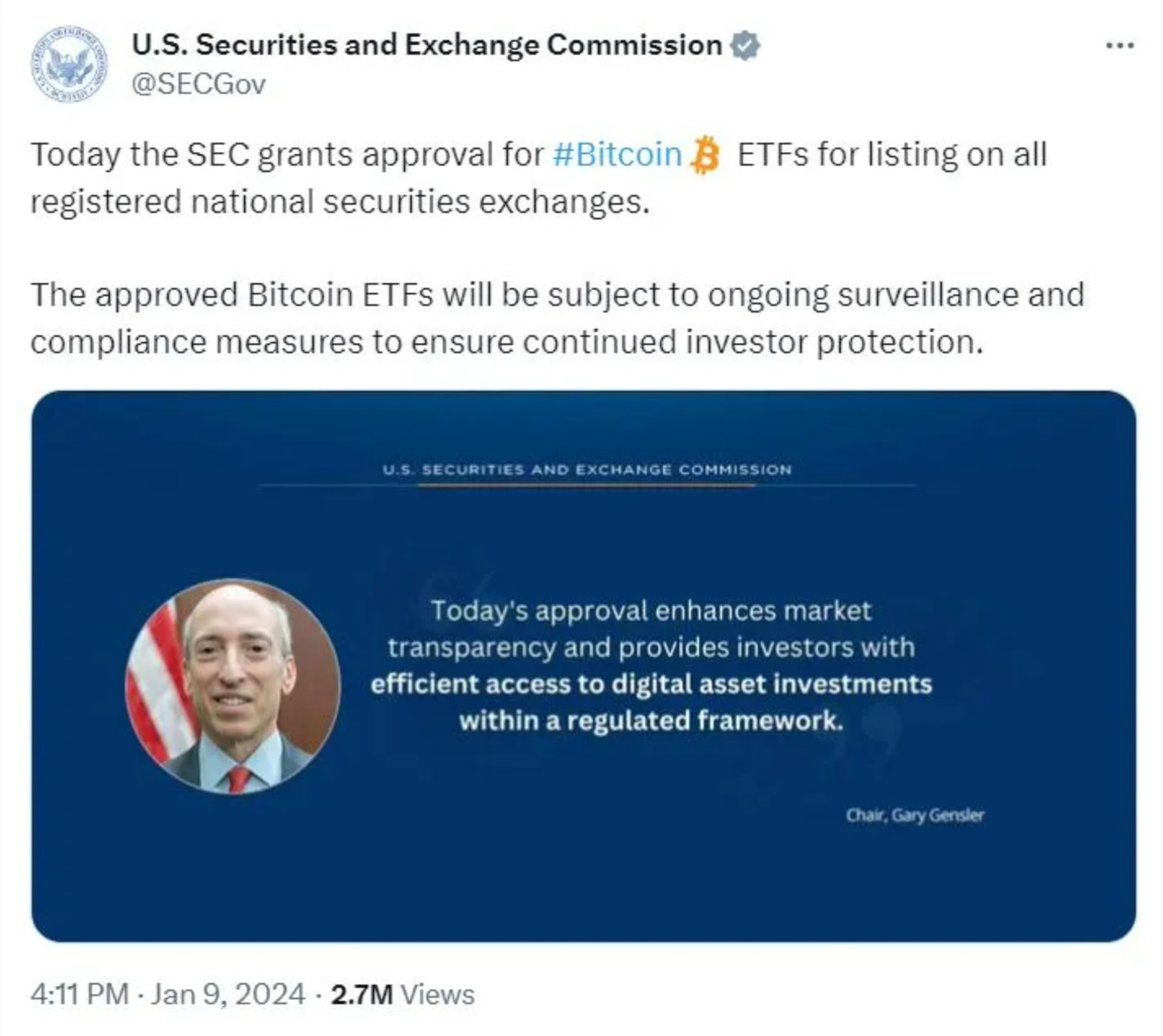
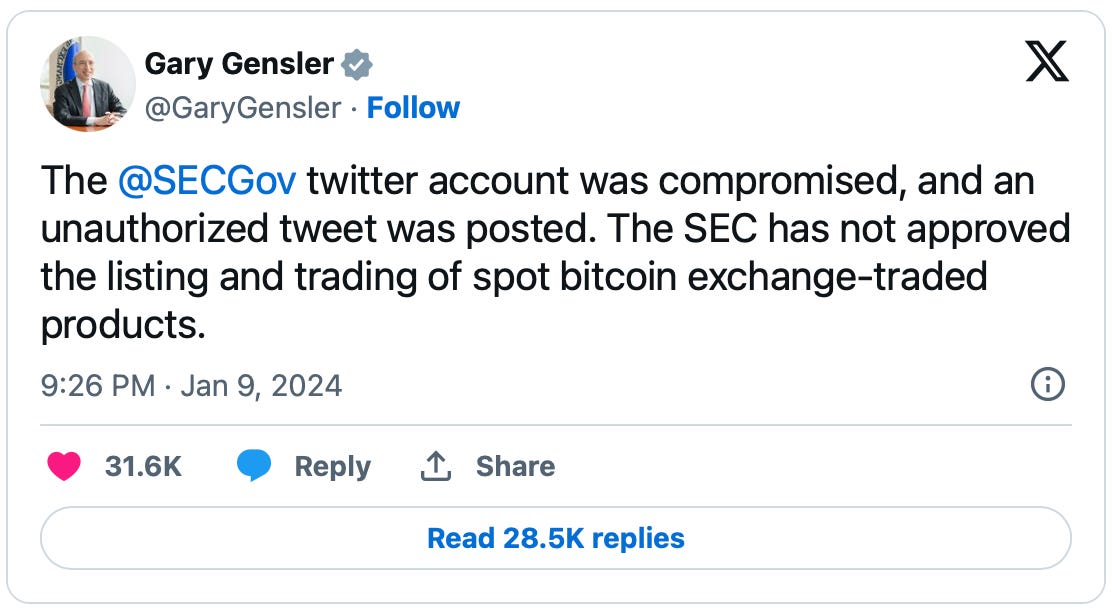
It certainly wasn’t unexpected news — although it was a day earlier than most (including BlackRock) had expected. However, approximately 15 minutes later, the SEC and Gensler published statements retracting the prior announcement, which caused the price of Bitcoin to plunge below the level it had started at. An article in Wired magazine noted that all of this amounted to a $40 billion swing in the combined value of Bitcoin (BTC) in circulation. With markets understandably in complete confusion at this point as to which way the wind was blowing (and with some traders already having lost serious money through the forced liquidations that ensued), we learned that a malicious actor had apparently gained access to the SEC’s Twitter (X) account. I say “apparently” because at this point it’s not clear to me that it’s prudent to believe a blind word the SEC says!
In response to all of this, the crypto-phobic WSJ immediately reached for its gaslight — running with the disingenuous headline “SEC Hack Adds to Unease Over Bitcoin ETF Approval”; adding the strap-line (in case the headline hadn’t done the trick) beginning with the words “Skeptics say the episode highlights longstanding concerns…”. Translated: the whole disaster was (yet again) crypto’s fault.
Of course, in the real world, the “longstanding concerns” most people were struggling with had nothing whatsoever to do with the state of crypto, but instead related to the SEC’s competence and integrity as a regulator — and more specifically to how on earth an agency tasked with protecting investors in the most powerful economy in the world could be so inept as to not be able to secure its own social media channels with two-factor authentication (2FA).
Either way, it was a really bad day at the office for Gensler — and it didn’t go unnoticed on the hill. Republican senators J. D. Vance and Thom Tillis cosigned a letter demanding answers, which underlined the fact that the incident was “antithetical to the Commission’s tripart mission to protect investors, maintain a fair, orderly and efficient market, and facilitate capital formation”. And indeed it was.
There were other critics too. As a Politico piece noted:
Congressional Republicans were quick to voice alarm. House Financial Services member Ann Wagner of Missouri said she is “deeply concerned” about the alleged hack, calling it “clear market manipulation.” Sen. Bill Hagerty of Tennessee, who sits on the Senate Banking Committee, called the SEC’s original post “unacceptable”.
“Just like the SEC would demand accountability from a public company if they made such a colossal market-moving mistake, Congress needs answers on what just happened,” Hagerty said on X.
Gensler has been asked to produce a comprehensive report on what the hell happened by no later than Monday. He must suddenly be feeling a bit like a schoolboy waiting to see the headmaster.
One further irony that’s worthy of mention is that Gensler actually had the casting vote on the ETF approvals, so he could have shot the whole thing down in flames. But he elected (presumably through gritted teeth) to approve them — I can only imagine because BlackRock would make an even more formidable foe than the ultra high-net-worth, billionaire-hating Elizabeth Warren when it comes to his future career prospects. Either way, after a year of bad news for the SEC, Gensler found himself (perhaps literally) between a rock and a hard place…
Stepping back from the affray for a moment, I guess there’s a beautiful form of poetic justice about the whole episode. The SEC has gone out of its way to delegitimise crypto based on illegitimate legal arguments — and in the process, all it has succeeded in doing is to delegitimise itself and its own authority as a regulator.
And this latest hacking pantomime is just the final delightful cherry on top…
SEC Commissioner Hester Peirce’s statement was extremely hard-hitting (she’s clearly had enough of the status quo at the SEC) and so it’s worth reading in full — but here’s a nice excerpt to get you in the mood:
We squandered a decade of opportunities to do our job. If we had applied the standard we use for other commodity-based ETPs [exchange-traded products], we could have approved these products years ago, but we refused to do so until a court called our bluff. And even now our approval comes only begrudgingly, as demonstrated by our continued insistence that these products satisfy a correlation test we have not demanded of prior commodity-based ETPs.
All-in-all, just another week in crypto! 😅
VANGUARD USERS THREATEN TO CLOSE ACCOUNTS AFTER FIRM BLOCKS SPOT BITCOIN ETFS
An amusing story on the back of the spot Bitcoin EFT approvals — Vanguard is clearly out of touch with its customer base and risks damaging its business as a result…
In brief:
Asset manager Vanguard’s apparent decision not to allow the purchase of spot Bitcoin exchange-traded funds (ETF) on its platform has seemingly pushed a few customers toward the exit door.
According to a Jan. 11 report from The Wall Street Journal, Vanguard said it won’t offer the new spot Bitcoin ETFs on its brokerage platform as they do not align with its traditional offerings.
“Spot bitcoin ETFs will not be available for purchase on the Vanguard platform,” said the company in a statement to the WSJ. “We also have no plans to offer Vanguard bitcoin ETFs or other crypto-related products.”
“Our perspective is that these products do not align with our offer focused on asset classes such as equities, bonds, and cash, which Vanguard views as the building blocks of a well-balanced, long-term investment portfolio.”
Link to full story: https://cointelegraph.com/news/vanguard-investors-threaten-to-close-accounts-ban-spot-bitcoin-etfs
BONUS LINK:
VANGUARD AMONG MICROSTRATEGY’S LARGEST SHAREHOLDERS, INDIRECTLY EXPOSED TO BITCOIN
ETHEREUM PRICE SOARS AS BITCOIN DROPS — DID ETH STEAL BTC’S THUNDER?
After the hack-induced false start previously mentioned, the Bitcoin price didn’t move upwards after the ETF approvals — which is what most people were expecting to happen. The reason? The Bitcoin EFT approvals had been largely priced in over the last 6 months, and investors are on to the next shiny new narrative — i.e. the potential approval later this year of a spot Ether ETF…
In brief:
In the past 60 days, Ether price has gained 27%, outpacing Bitcoin’s 24% positive move in the same period — quite a feat considering that the spot BTC approval was expected to catapult its price as it opens room for a whole new set of clients who could not acquire cryptocurrency directly. Furthermore, Bloomberg ETF analysts hold 70% odds of an Ethereum ETF approval by May, as opposed to their 95% chances for Bitcoin.
BlackRock, Fidelity, Grayscale, VanEck and other asset managers expect the final U.S. Securities and Exchange Commission deadline on the spot Ethereum ETF decision by May 23, but given that Bitcoin already paved the way, some analysts believe the final answer might come sooner than anticipated. For instance, the SEC has intermediary deadlines in late January for some of the applicants.
Link to full story: https://cointelegraph.com/news/ethereum-price-soars-as-bitcoin-drops-did-eth-steal-btc-thunder
BLACKROCK CEO LARRY FINK TALKS CRYPTO AND TOKENISATION
Larry Fink is back on the media circuit once more, talking about crypto — after the approval of the company’s spot Bitcoin ETF. But whilst Bitcoin and Ethereum are clearly important talking points, the main underlying focus is (in my view understandably) shifting towards the transformation of TradFi through the tokenisation of assets…
In brief:
According to Fink, tokenisation is a significant technological advancement that can revolutionise how assets are handled. It involves converting rights to an asset into a digital token on a blockchain. Therefore, he sees this as a future where transactions are recorded instantly, and ownership can be transferred seamlessly, enhancing efficiency and transparency in the financial system.
“We have the technology to tokenise today. If you have a tokenised security and identity, the moment you buy or sell an instrument on a general ledger, that is all created together. You want to talk about issues around money laundering. This eliminates all corruption by having a tokenised system,” Fink explained.
Link to full story: https://beincrypto.com/blackrock-larry-fink-bitcoin-ethereum-tokenization/
X CALLS IT QUITS ON NFT PROFILE PICS
In brief:
X discontinued support for NFT profile pictures this week after first launching the feature in January 2022.
Under the direction of crypto-friendly CEO Elon Musk, the profile pictures became a paid feature, though Musk has seemingly soured on the concept.
Users of the feature opened the app Wednesday to find their formerly-hexagonal profile pictures to be circular once again.
Neither Musk nor X have publicly commented on the reasoning behind the change.
Ironically, Musk — who became a public voice in the crypto world during the last bull run — inherited the NFT project and saw it killed under his tenure. For crypto-interested X users, hopeful Musk-led crypto integrations have largely not come to pass.
Link to full story: https://blockworks.co/news/x-profile-pictures-and-failed-bitcoin-moon-landing
MICROSTRATEGY BITCOIN STASH NOW WORTH MORE THAN THE COMPANY ITSELF
In brief:
Bitcoin hoarder MicroStrategy has so far struggled in the New Year, and spot bitcoin ETFs seem to be making it worse.
Shares in the data software firm have slipped more than 20% so far this month, wiping about $4 billion from its market value.
Bitcoin (BTC) meanwhile is up more than 10% in January. MSTR has still nearly tripled in the past year.
MicroStrategy holds 189,150 BTC ($8.7 billion) on its balance sheet, which awkwardly means its bitcoin is worth over $1 billion more than the actual company.
Link to full story: https://blockworks.co/news/microstrategy-bitcoin-valuation
That’s all for this week — until next time! 🫡
Great write up brother! It's my old school money managing days telling me that once it reaches the masses it's time to get out of the game because history shows us it's the masses that always get left with the bag... however knowing that now makes everyone as knowledgable as the house casino and anyone can place their bets accordingly... not financial advice